We collect, analyze and brief. Your account executives act.
An overview, followed by redacted client examples. Shown in G2SAS format. Your own format can be used.


Field Intelligence is the function that prepares account executives to pursue the right accounts, reach the right stakeholders, and win the opportunities in front of them. Revenue intelligence and sales intelligence tools were built for business development and inside sales teams running high-volume outreach. Field Intelligence is built for the seller who owns the deal. Software collects. Field Intelligence analyzes, decides, and briefs.
The gap this fills
Business development reps have data platforms and sequencing tools built around them. Marketing has intent and account-based platforms. Account executives inherit whatever was handed off and do their own research the night before the call. The seller who decides whether a deal is won is the seller with the least intelligence support.
The G2 Field Intelligence Service is a retained intelligence function for your account executives. We gather the intelligence, filter it through our go-to-market strategy and execution experience, and deliver it inside the workflow artifacts your AEs already use.
What this is not
- Not outsourced prospecting. We do not make calls, send emails, or book meetings. Your account executives own every conversation.
- Not BDR or inside-sales tooling. We do not build lists or run campaigns. The output is a plan a seller executes and a manager inspects, not a list a tool acts on.
- Not field sales mapping software. This is account and stakeholder intelligence your sellers act on, not route planning for outside reps.
Three plans, one for each job an AE owns
Prospecting Plan
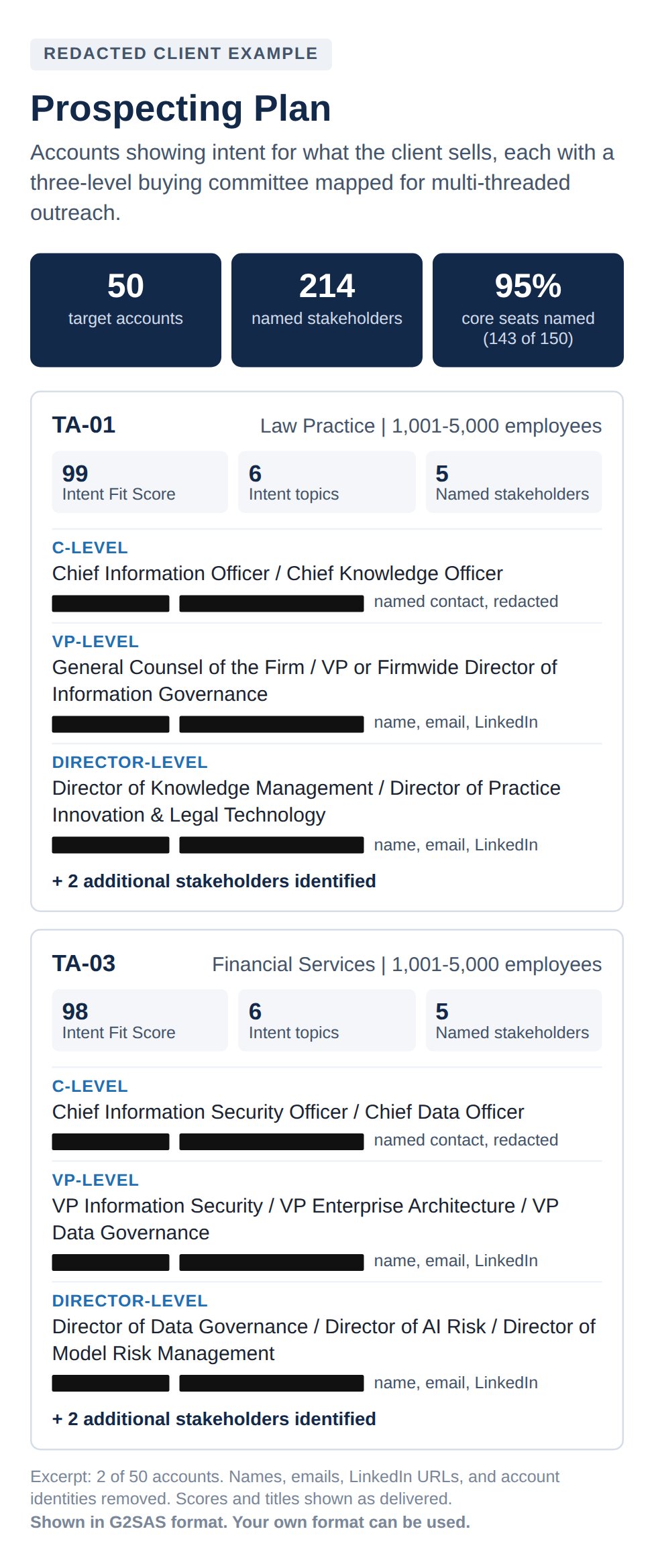
For the account executive’s own pipeline building. Names the accounts to pursue, the buying signal or company event that makes them timely, the stakeholders to reach, verified contact details, and the opening angle for each role.
Opportunity Plan
For live deals. Applies a structured qualification framework to the specific opportunity: decision criteria, decision process, economic buyer, paper process, identified pain, competition, and the next commitments to secure. Tells the AE what is missing and what to do about it.
Account Plan
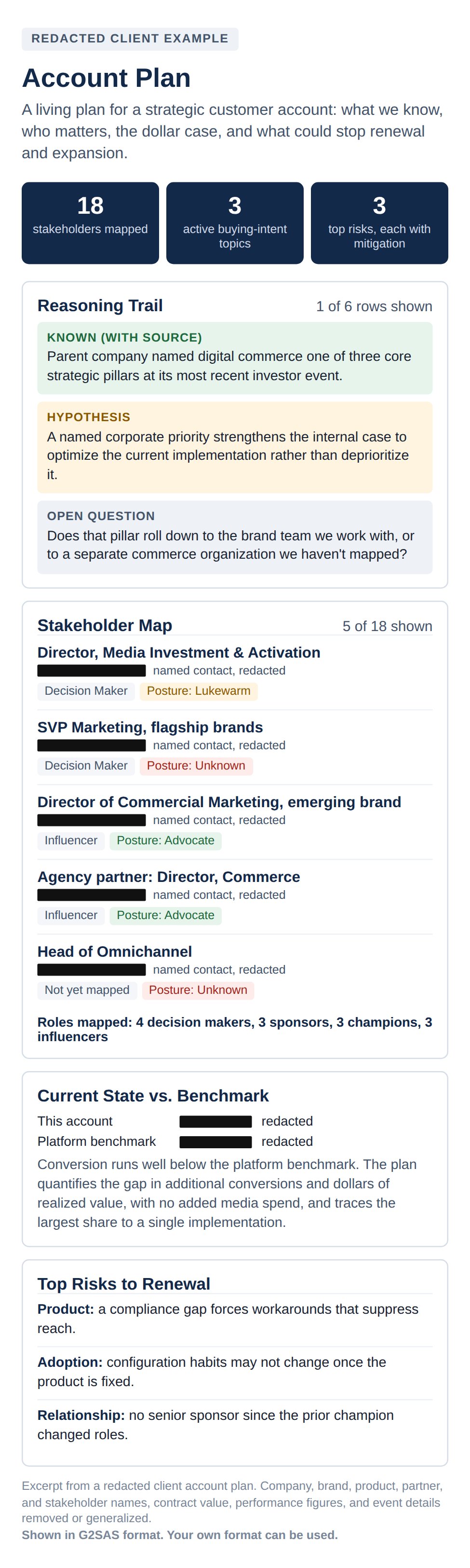
For strategic accounts in territory. Maps the buying committee, identifies champions, sponsors and blockers, documents the installed technology stack, and lays out a penetration path grounded in how the account actually buys.
What goes into every plan
- Buying signals and company events that indicate timing: funding, leadership change, expansion, technology shifts, and AI-related initiatives
- Stakeholder identification across the buying committee, with role-level guidance on how each person evaluates and decides
- Verified email and phone contact information for the individuals named in the plan
- Technology stack intelligence to inform fit, integration, and competitive positioning
- Selling guidance drawn from operator experience: message angles, qualification gaps, and the sequence of conversations most likely to advance the pursuit
We source from multiple commercial data and AI platforms and are not tied to any single vendor. The platforms are inputs. The plan is the product.
Why it works
Hard ROI: win rate. Better account and contact intelligence, combined with account executives consistently following recommended best practices across prospecting, opportunity and account plans, changes outcomes in the deals that matter. Win rate is the measure we hold ourselves to.
Soft ROI: research time returned to selling. AEs stop spending hours assembling context before a call. Salesforce’s State of Sales research finds reps spend just 28% of their week actually selling. We treat this as secondary. Saved time only matters if it is redeployed, and the plan is what makes redeployment productive.
How engagements begin
Every G2 Field Intelligence Service engagement starts with a GTM Strategy Checkpoint: a paid diagnostic using our seven-stage Market Map to confirm ideal customer profile, buying committee definition, and sales motion before any plan is produced. Plans built on a misaligned strategy produce disciplined pursuit of the wrong accounts. The Checkpoint prevents that.
Following the Checkpoint, the retained service is scoped to the accounts under plan, the mix of plan types required, and the refresh cadence.
Who this is for
B2B technology companies with quota-carrying account executives running complex, multi-stakeholder deals, where the cost of pursuing the wrong account or mishandling a live opportunity is material. Typical sponsors are the CEO, CRO, or VP of Sales.
Delivery
Virtual-first. Plans are delivered as documents your team can use immediately and reviewed with sales leadership on a fixed cadence. Principal involvement throughout.
Start with the GTM Strategy Checkpoint. Contact G2 Strategic Advisory Services.